
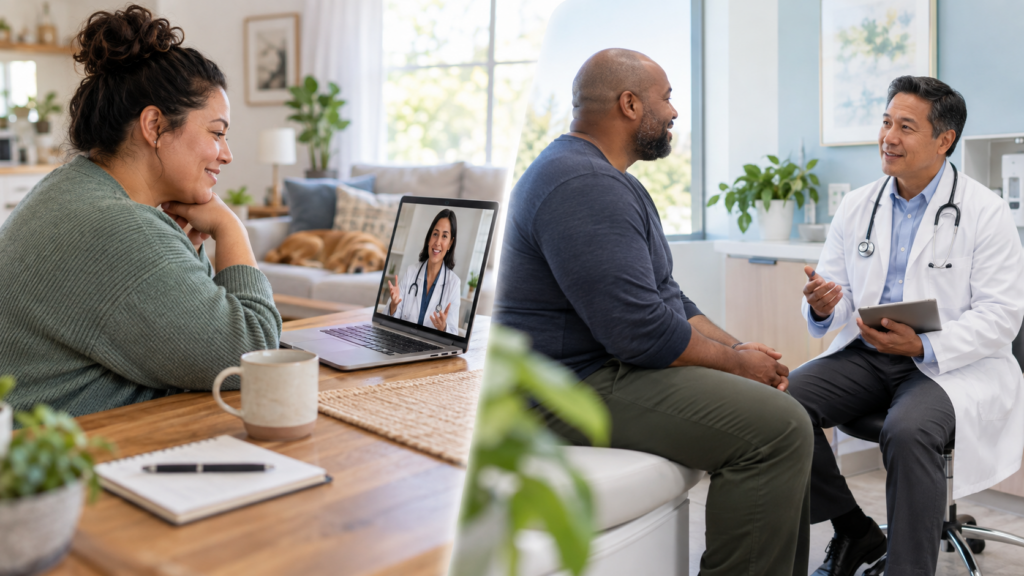
Telehealth weight-loss programs and in-person clinics can both provide medically guided weight management. The better option depends on your health needs, location, schedule, treatment preferences, and whether you require physical examinations, testing, or hands-on care.
Telehealth may be a convenient choice for people who want to meet with a licensed provider from home, receive ongoing virtual support, and have eligible prescriptions delivered. An in-person clinic may be more appropriate when a patient needs a physical examination, testing that cannot be completed remotely, or closer face-to-face monitoring.
Neither format is automatically better for every patient. What matters most is the quality of the medical evaluation, the provider’s credentials, the transparency of the treatment plan, and the availability of continued support.
What Is a Telehealth Weight-Loss Program?
A telehealth weight-loss program provides medical evaluation and ongoing weight-management care through virtual appointments. Patients typically submit health information and meet with a licensed provider using a secure online platform.
The provider may review:
- Current weight and health goals
- Medical history
- Current medications
- Previous weight-loss attempts
- Existing health conditions
- Possible treatment risks
- Symptoms that may affect treatment
- Whether additional testing is appropriate
If the patient qualifies, the provider may recommend a personalized weight-management plan. Depending on the program and the patient’s medical needs, treatment may include prescription medication.
Morph Wellness MD uses a virtual process that begins with a consultation. Patients then meet with a licensed provider who evaluates their needs and creates an individualized plan. When medication is prescribed, it can be delivered directly to the patient.
What Is an In-Person Weight-Loss Clinic?
An in-person weight-loss clinic requires patients to visit a physical location for some or all of their care. The services offered vary by clinic and may include medical consultations, physical examinations, weight monitoring, laboratory testing, or other assessments.
Some clinics provide comprehensive medical care, while others focus on a limited range of programs or products. Visiting a physical location does not automatically guarantee higher-quality care. Patients should still investigate the provider’s credentials, treatment methods, pricing, medication sourcing, and follow-up procedures.
The main difference is how care is delivered. Telehealth uses virtual communication, while an in-person clinic provides face-to-face appointments at a physical facility.
Telehealth vs. In-Person Weight-Loss Care at a Glance
| Area | Telehealth program | In-person clinic |
|---|---|---|
| Appointments | Completed virtually | Completed at a physical location |
| Travel | Usually unnecessary | Required for clinic visits |
| Scheduling | May offer greater flexibility | Depends on office hours |
| Physical examination | Limited remotely | Can be performed on-site |
| Testing | May require an outside facility | May be available at the clinic |
| Follow-up support | Virtual visits, messaging, or calls | Office visits and possibly remote support |
| Medication delivery | May be shipped when prescribed | May be picked up or shipped |
| Geographic access | Depends on provider licensing | Depends on clinic location |
| Best suited for | Stable patients appropriate for remote care | Patients who require hands-on evaluation |
Individual programs differ, so patients should confirm exactly what is included before choosing either option.
Is Telehealth More Convenient Than an In-Person Clinic?
Telehealth is often more convenient because patients can attend appointments from home or another private location. This can reduce travel time, waiting-room time, and disruption to work or family responsibilities.
It may be especially useful for patients who:
- Live far from a medical weight-loss clinic
- Have limited transportation
- Travel frequently
- Have demanding work schedules
- Prefer receiving care privately at home
- Want virtual access to ongoing support
Convenience should not replace appropriate medical care. A responsible telehealth provider should recommend in-person evaluation when a patient’s symptoms or circumstances cannot be assessed safely online.
Morph Wellness MD provides virtual consultations and ongoing check-ins, which can make it easier for eligible patients to stay connected with their care team without making repeated trips to a clinic.
Which Option Provides Better Access to Medical Providers?
Access depends more on the individual program than on whether care is virtual or in person.
A telehealth company may provide direct access to licensed providers and frequent virtual follow-ups. Another program may conduct one brief initial consultation and provide little meaningful contact afterward. The same differences can exist among physical clinics.
Patients should ask:
- Who conducts the initial evaluation?
- Will I see a licensed provider?
- Is the provider authorized to treat patients in my state?
- Can I ask questions between appointments?
- How often will my progress be reviewed?
- Who should I contact about side effects?
- Will I see the same provider during follow-up visits?
Morph Wellness MD offers unlimited check-ins as part of its weight-management approach. This gives patients a way to communicate with the care team as treatment progresses.
Can a Telehealth Provider Prescribe Weight-Loss Medication?
A licensed telehealth provider may prescribe weight-management medication when it is medically appropriate and permitted by applicable laws. Patients should not assume that completing an online form guarantees a prescription.
Before recommending treatment, the provider should review the patient’s health information, potential contraindications, current medications, and other relevant factors. Additional information or testing may be needed before a decision can be made.
Prescription weight-management medications are not interchangeable. Different medications have different indications, dosing instructions, risks, and monitoring considerations. Some medications may be appropriate for certain patients and inappropriate for others.
The National Institute of Diabetes and Digestive and Kidney Diseases advises patients to discuss the potential benefits, risks, expected duration, costs, and possible weight regain associated with prescription weight-management medication.
Does In-Person Care Offer Advantages?
Yes. In-person clinics can perform physical examinations and may offer testing or measurements during the same visit. This can be useful when symptoms require hands-on evaluation or when the provider needs information that cannot be obtained reliably through a virtual appointment.
An in-person clinic may be preferable if:
- You need an immediate physical examination
- You have complex or unstable medical conditions
- You are experiencing concerning symptoms
- Your provider recommends on-site testing
- You are uncomfortable using telehealth technology
- You strongly prefer face-to-face appointments
- Reliable internet access is unavailable
A responsible telehealth program should recognize these limitations. Remote care is most effective when the patient’s needs can be evaluated and managed appropriately through telehealth.
How Does Medication Delivery Compare?
Many telehealth programs arrange for prescribed medication to be delivered to the patient’s home. This can simplify treatment for patients who prefer not to make separate pharmacy visits.
In-person clinics may dispense certain products, send prescriptions to a pharmacy, or arrange delivery. Patients should verify the process rather than assuming medication is included.
Regardless of the care format, ask:
- What medication is being prescribed?
- Is the medication FDA-approved for the prescribed use?
- Is it a compounded medication?
- Which pharmacy will fill the prescription?
- Is the pharmacy appropriately licensed?
- Is medication included in the advertised price?
- How should the medication be stored?
- Who should be contacted if a shipment is delayed or damaged?
Compounded medications are not FDA-approved and do not undergo the FDA’s premarket review for safety, effectiveness, or quality. Patients should receive accurate information about whether a prescribed medication is FDA-approved or compounded.
Morph Wellness MD can arrange doorstep delivery when medication is prescribed. Patients should review the details of their individual prescription and ask any questions they have before beginning treatment.
Which Option Offers More Personalized Treatment?
Both telehealth and in-person providers can deliver personalized care. The method of communication does not determine the quality of personalization.
A personalized program should consider:
- Your health history
- Previous weight-management efforts
- Treatment goals
- Medication tolerance
- Changes in symptoms
- Progress over time
- Personal preferences
- The need to adjust the plan
Be cautious if every patient receives the same medication, dose, or schedule without an individualized assessment.
Morph Wellness MD develops custom treatment plans and provides custom dosing when appropriate. The care team can review the patient’s response and determine whether changes should be considered.
How Important Is Ongoing Monitoring?
Ongoing monitoring is important regardless of whether care occurs online or in person. Weight-management treatment may need to change based on progress, medication tolerance, side effects, health changes, or the patient’s goals.
Follow-up care may help the provider evaluate:
- How the patient is responding
- Whether side effects are occurring
- Whether dosing instructions are being followed
- Whether a treatment adjustment is appropriate
- Whether additional medical evaluation is needed
- What barriers are affecting progress
An online program with responsive medical support may provide better continuity than a physical clinic that offers only occasional appointments. Conversely, an in-person clinic may be more appropriate for a patient who requires closer hands-on observation.
Compare the actual follow-up services instead of judging the program only by its location.
Do Telehealth and In-Person Programs Cost the Same?
Costs vary widely. Telehealth can reduce expenses associated with travel and time away from work, but the program itself is not always less expensive. In-person clinics may charge separately for consultations, testing, follow-ups, medication, or other services.
Before enrolling, request a complete explanation of:
- Consultation costs
- Membership fees
- Medication costs
- Shipping charges
- Follow-up appointment fees
- Laboratory expenses
- Supplies
- Dose-related price changes
- Cancellation policies
- Refund policies
Morph Wellness MD provides consultations with no consultation fee. Patients should still confirm the full cost of any recommended weight-management program before beginning treatment.
The least expensive option is not necessarily the best value. Provider access, monitoring, treatment transparency, and continued support should also be considered.
How Can You Compare the Quality of Two Programs?
Use the same criteria when comparing telehealth programs and physical clinics.
Provider credentials
Confirm that your care will involve a licensed medical professional who is authorized to practice in your state.
Individual evaluation
The program should review your health history before recommending treatment.
Treatment transparency
You should know what is being prescribed, why it is being recommended, and whether the medication is FDA-approved or compounded.
Pharmacy transparency
The company should identify the pharmacy filling your prescription and explain how the medication will be delivered.
Follow-up access
You should know how often the provider will review your progress and whom to contact with questions.
Realistic expectations
The program should not guarantee a particular amount of weight loss or suggest that one treatment works for everyone.
Long-term planning
The provider should discuss how treatment fits into a broader weight-management plan rather than presenting medication as the only important factor.
Who May Prefer a Telehealth Weight-Loss Program?
Telehealth may be a good fit for someone who:
- Is medically appropriate for remote care
- Values convenience and privacy
- Wants to avoid regular travel
- Can communicate comfortably through video, phone, or messaging
- Wants medication delivered when prescribed
- Has a stable internet connection
- Has access to in-person care when necessary
Eligibility for telehealth does not guarantee eligibility for prescription medication. A provider must make that decision after reviewing the individual’s health information.
Who May Prefer an In-Person Clinic?
An in-person clinic may be preferable for someone who:
- Needs a physical examination
- Requires frequent on-site testing
- Has complex health concerns
- Experiences symptoms that need hands-on evaluation
- Prefers face-to-face communication
- Has difficulty using virtual technology
- Wants care delivered at one physical location
Some patients may use a combination of virtual and in-person care. For example, routine follow-ups may happen remotely while testing or certain evaluations take place locally.
Frequently Asked Questions
Is online medical weight loss as effective as in-person treatment?
The quality and potential effectiveness of care depend on the provider, treatment plan, patient’s health needs, adherence, and ongoing monitoring. Telehealth can provide appropriate medical weight management for some patients, but it is not suitable for every situation.
Can I start a telehealth weight-loss program without visiting a clinic?
Some patients may complete their consultation and follow-up care virtually. Others may need laboratory testing, a physical examination, or an in-person evaluation before or during treatment. The provider should explain what is required based on your circumstances.
Is weight-loss medication included with every telehealth program?
No. Some programs include medication in their advertised price, while others charge separately. A consultation also does not guarantee that medication will be prescribed. Always request a complete explanation of costs and eligibility requirements.
What happens if I experience side effects during virtual treatment?
Contact the prescribing provider according to the program’s instructions. Depending on the symptoms, the provider may recommend monitoring, changing the plan, arranging an in-person evaluation, or seeking urgent or emergency care. Severe or rapidly worsening symptoms should not wait for a routine virtual appointment.
How do I know whether telehealth is right for me?
Consider your medical needs, comfort with virtual appointments, access to local care, schedule, treatment preferences, and need for physical examination or testing. A licensed provider can help determine whether your needs can be managed appropriately through telehealth.
Conclusion
Telehealth weight-loss programs can provide convenient access to physician-guided care, virtual follow-ups, personalized treatment, and medication delivery when prescribed. In-person clinics provide hands-on examinations and may offer on-site testing that cannot be completed remotely.
The right choice depends on the patient. Instead of focusing only on whether a program operates online or in a clinic, examine the qualifications of its providers, the depth of its medical evaluation, the transparency of its medication practices, and the availability of continued support.
Morph Wellness MD offers virtual weight-management care designed around individualized treatment. Patients can book a consultation, meet with a licensed provider, receive a custom plan, and have prescribed medication delivered to their door. Unlimited check-ins allow patients to remain connected with their care team throughout the process.